

Macro photography rewards curiosity. The closer you get, the more a flower petal, insect eye, or watch gear stops looking like a snapshot and starts looking like a specimen. The challenge is that macro has its own vocabulary—and that vocabulary is what most people type into Google when they get stuck.

This guide explains the terms you will see on lens specs and in tutorials, in plain language. Along the way, it shows how those ideas map onto Laowa’s Ultra Macro APO lineup—so when you are ready to choose a lens, you are choosing for a reason, not because of a buzzword.
What counts as “macro” photography?
In everyday camera marketing, “macro” often means “focuses closer than usual.” In optics, true macro usually means the subject is projected onto the sensor at life size or larger.
That life-size benchmark is written as 1:1 (or 1×). Anything less—say 1:2 (half life-size)—is still useful close-up work, but it is not true macro by the strict definition. Anything more—2:1 / 2×, 5×, and so on—is higher magnification: the subject on the sensor is bigger than it is in real life.
Why the fuss? Because at 1:1 and beyond, depth of field collapses, lighting gets harder, and camera shake shows up as blur. Knowing the terms below helps you read a lens chart and predict those problems before you buy.
Magnification and reproduction ratio
Magnification (also called reproduction ratio) describes how large the subject appears on the sensor compared with real life.
| You see | It means |
|---|---|
| 1:1 or 1× | Life-size on the sensor |
| 2:1 or 2× | Twice life-size |
| 5× | Five times life-size |
| 1:2 | Half life-size (close-up, not strict macro) |
Maximum magnification is simply the highest ratio the lens can reach—usually at its closest focus. When a zoom is labeled “macro” but only reaches 0.3×, it is a close-focus zoom, not a true macro lens.
Crop sensors do not change magnification. A 1:1 image is still life-size on the sensor whether you shoot full frame, APS-C, or Micro Four Thirds. Crop does change how much of that subject fills the frame, which can make the same lens feel “tighter.”
Laowa in practice: Most Laowa Ultra Macro APO primes go to 2×, so you can fill the frame with details that a classic 1:1 lens leaves small. The specialist Laowa 25mm f/2.8 2.5–5X Ultra Macro goes further still, from 2.5× to 5×, for extreme texture and tiny subjects.

Minimum focus distance vs working distance
These two numbers are often confused—and they answer different questions.
Minimum focus distance (MFD) is measured from the sensor (or film) plane to the subject. It is the optical distance printed on many spec sheets.
Working distance is the gap from the front of the lens to the subject. That is the space you actually care about when you are trying not to scare an insect, cast a shadow, or bump a flash into a flower.
A longer focal length at the same magnification usually gives more working distance. A short, high-magnification optic can force you almost on top of the subject.
Laowa in practice:
- Tele-style macros such as the 90mm f/2.8 2x Ultra Macro APO and 100mm f/2.8 2x Ultra Macro APO are popular for insects because you can stay farther back while still hitting 2×.
- The 24mm f/14 2x Macro Probe flips the idea: a long tubular barrel with a tiny tip that can get within about 20 mm of the subject—useful for “bug’s-eye” angles, product inserts, and shots through foliage or liquid that a normal lens cannot reach.

APO (apochromatic): why color fringing matters at high magnification
At high magnification, chromatic aberration—color fringing—becomes obvious on edges and specular highlights. An APO (apochromatic) design aims to bring different wavelengths of light into focus together, reducing those rainbow edges.
In photography marketing, “APO” usually signals strong control of axial and lateral color. For macro shooters, that means less purple/green fringing to clean up in post, especially when you are already fighting shallow depth of field and stacking.
Laowa in practice: Lenses named Ultra Macro APO—including the 50mm, 58mm, 65mm, 90mm, and 100mm 2× models—are built around that color-control brief for close work.

Depth of field, diffraction, and focus stacking
At 1:1 and especially at 2×–5×, depth of field can shrink to a fraction of a millimeter. Stopping down (higher f-number) adds depth, but extreme apertures soften the image through diffraction.
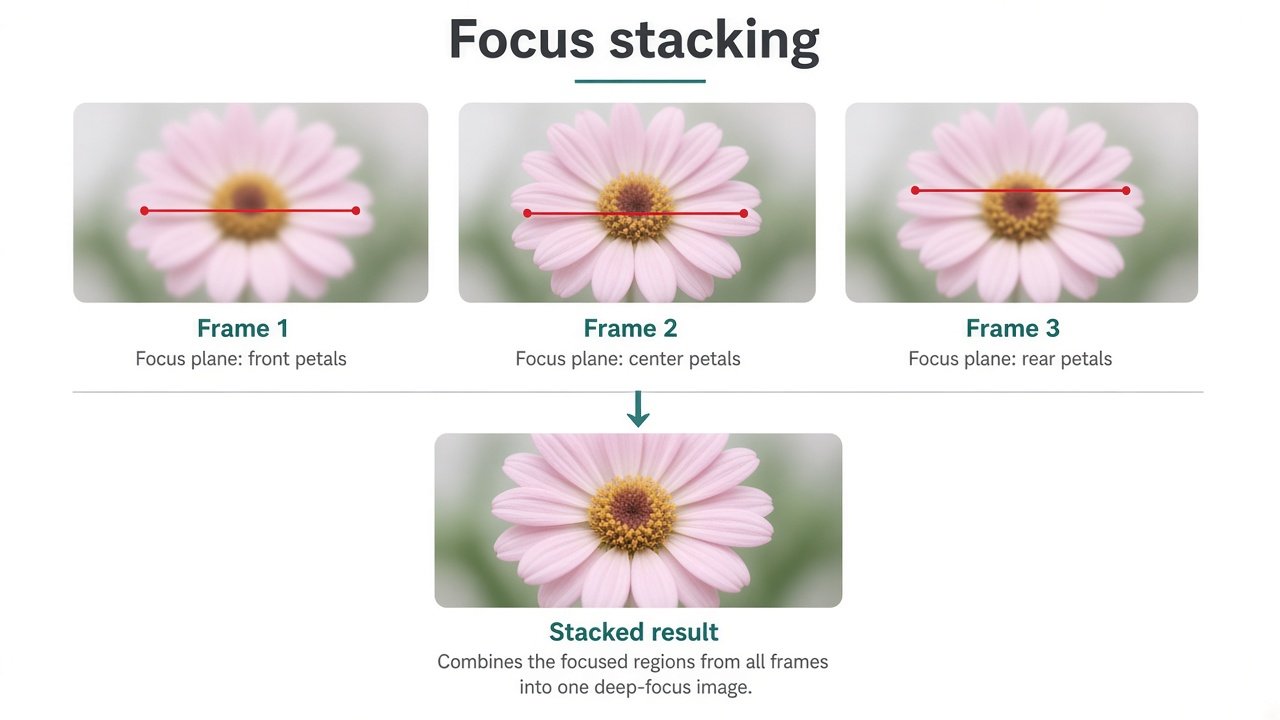
The practical answer for many studio and still-life shooters is focus stacking: shoot a sequence while shifting focus slightly between frames, then blend the sharp slices in software into one deeper image. Field shooters often combine a moderate aperture, careful subject choice (side-on insects, flatter flowers), and a sturdy support.
You do not need stacking for every shot. You do need to expect that “just stop down to f/22” is not always a free sharpness upgrade at high magnification.
Extension tubes vs a dedicated macro lens
Extension tubes are hollow spacers between camera and lens. They let a normal lens focus closer and reach higher magnification. There is no glass inside, so they are affordable—but you usually lose infinity focus, lose some light, and may see softer edges.
A dedicated macro lens is optically designed for close distances: flatter field, stronger sharpness near minimum focus, and (on most true macros) the ability to focus from infinity down to the macro range in one optic.
Laowa in practice: The 2× APO primes keep infinity focus, so the same lens can do field macro in the morning and a tight portrait or detail shot later. The 25mm 2.5–5× is the exception in this list: it is a macro-only optic (no infinity), purpose-built for extreme magnification.
How to match a Laowa macro to your camera and subject
Once the terms make sense, lens choice gets simpler. Use this as a practical map—not a ranking.
Full-frame mirrorless: everyday 2× workhorses
- Laowa 90mm f/2.8 2x Ultra Macro APO — Compact full-frame 2× with internal focusing. A strong all-rounder for insects, plants, and product detail, with mounts across major mirrorless systems (and an MFT variant).
- Laowa 100mm f/2.8 2x Ultra Macro APO — Classic tele-macro length: a little more reach for skittish subjects, and a natural short-tele look when you focus farther out.
- Laowa 58mm f/2.8 2x Ultra-Macro APO — Shorter full-frame 2×. At the same magnification you tend to see more of the environment around the subject—handy for product, food, and “context macro,” not only isolated bug portraits.
APS-C and Micro Four Thirds
- Laowa 65mm f/2.8 2x Ultra Macro APO — Designed for APS-C. Light and short, with a ~97.5mm full-frame-equivalent field of view—ideal as a dedicated crop-body field macro.
- Laowa 50mm f/2.8 2X Ultra Macro APO — Micro Four Thirds only. Roughly a 100mm-equivalent framing feel, pocketable, with camera-controlled aperture on MFT bodies.
Specialists: extreme magnification and creative probe shots
- Laowa 25mm f/2.8 2.5–5X Ultra Macro — When 2× is not enough. Think tiny insects, textures, and scientific-style detail. Plan on a tripod, careful lighting, and often focus stacking; working distance is short (~40–45 mm).
- Laowa 24mm f/14 2x Macro Probe — A wide, tubular probe with a waterproof front section and tip LED. Built for angles no normal macro can reach: through bottles, under leaves, into small sets for photo or cinema.
Always confirm the current mount list for your body before you buy—Laowa expands mounts over time.
Product reference photos


A simple learning path (search intent → practice)
- Learn the ratio — Decide whether you need true 1:1, room to grow to 2×, or extreme 5× work.
- Protect working distance — Insects and nervous subjects favor longer focal lengths; product and controlled sets can use shorter macros or a probe.
- Watch color — At high mag, APO designs reduce cleanup time.
- Plan for depth of field — Practice a moderate aperture first; add stacking when the subject is static.
- Match the sensor — Full-frame, APS-C, and MFT each have dedicated Laowa options; do not buy an APS-C-only or MFT-only lens for the wrong body.
FAQ
What does 1:1 mean in macro photography?
It means life-size: a 10 mm subject occupies 10 mm on the sensor. That is the usual threshold for calling a lens “true macro.”
Is 2× better than 1:1?
Not automatically—it is more magnification. 2× lets you fill the frame with smaller details, but depth of field gets thinner and technique matters more. Many Laowa Ultra Macro APO lenses top out at 2× so you can choose 1:1 or go deeper without changing lenses.
Does a crop sensor increase magnification?
No. Magnification is measured at the sensor. Crop sensors crop the field of view, so the same subject can fill more of the frame, which looks like more reach.
What is working distance in macro?
The clear space from the front of the lens to the subject. It is often more useful day-to-day than minimum focus distance, which is measured from the sensor plane.
Do I need focus stacking for macro?
Only when you need more depth of field than a single aperture can give without softening the image. Static subjects (products, still life, cooperative insects on a calm day) are good stacking candidates.
What does APO mean on a Laowa macro lens?
It points to an apochromatic-oriented design that aims to reduce color fringing—especially valuable when shooting shiny or high-contrast details at high magnification.
Key takeaways
- True macro starts around 1:1; Laowa’s Ultra Macro APO primes commonly offer 2× headroom.
- Read working distance, not only minimum focus distance, when you shoot living subjects.
- APO designs help keep color clean when magnification climbs.
- Match format (full frame, APS-C, MFT) and use case (field insects, product, extreme detail, probe/creative) before you compare focal lengths.
When you are ready to go from terms to glass, browse the Laowa macro lineup on Venus Lens and open the product page for your mount. The specs will make more sense the second time you read them.


Leave A Comment